



In the Seeing to understand article series, the University of Dunaújváros presents the personal and professional experiences of its lecturers who have participated in international mobility programmes. Through their stories, we gain insight into how international cooperation becomes a tangible experience beyond agreements, official visits and institutional frameworks.
In the second part of the series, Tamás Zahola, Master Instructor at UoD, shares his experiences from China. During his third visit to the country, he spent two weeks at Qingdao Harbour Vocational & Technical College in May 2026.
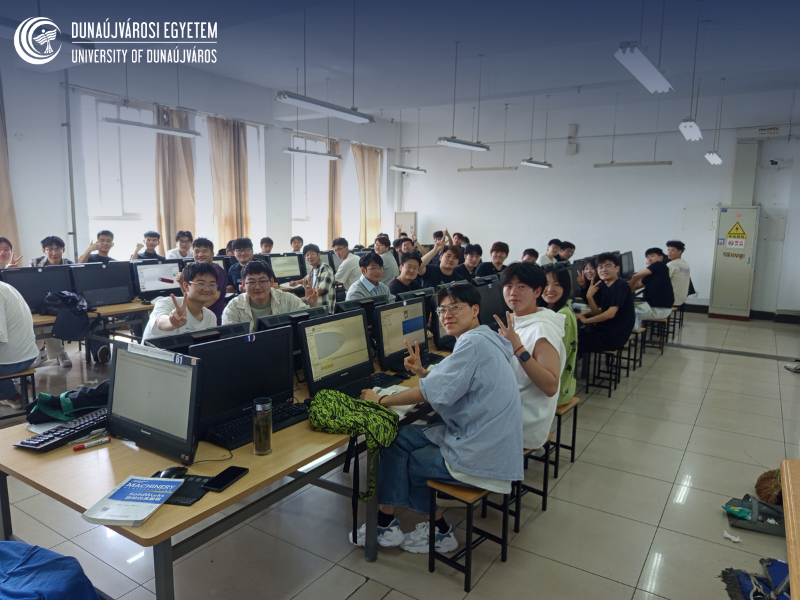
(Engineering students during Tamás Zahola's teaching mobility at Qingdao Harbour Vocational & Technical College. Photo: Tamás Zahola)
Reflecting on the title of the series, Seeing to understand, Tamás Zahola highlighted that most people develop an image of China from an early age: an image of its size, distance and significance. However, when one actually travels there for the first time, this imagined scale becomes multiplied.
The approximately 12-hour flight from Hungary to Shanghai already gives a clear sense of distance. This was followed by another flight to Beijing, from where he continued his journey towards Qingdao. What is perhaps even more striking is the scale of distances within China itself: the journey from Beijing to the college included a 600 km trip by high-speed train, which still took approximately 3 hours. The scale of China is also reflected in Qingdao itself. Although it is not among the country’s most internationally known cities, its population is close to 10 million.
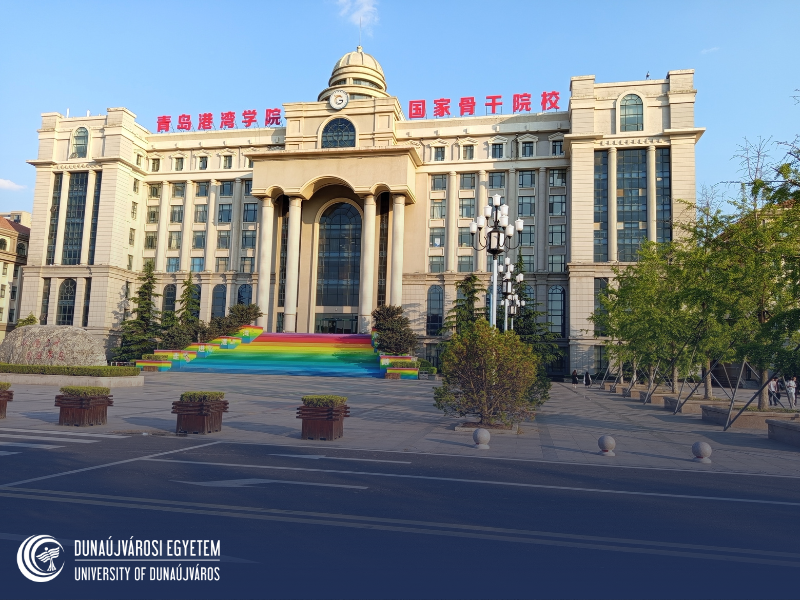
(The main campus of Qingdao Harbour Vocational & Technical College in Qingdao, China. Photo: Tamás Zahola)
The size of the college is also remarkable, with approximately 10,000 students studying at the institution.
Qingdao is a port city, and this character strongly influences both local life and education. The college’s professional profile is closely connected to shipping, port operations and technical training.
During his visit, Tamás Zahola taught the fundamentals of machine design and technical drawing, as well as Mechanics II, in an intensive format. Delivering the material of an entire semester within two weeks was a significant challenge both for the students and for the lecturer.
Based on his experience, Chinese students’ English language skills are generally stronger in reading and writing. At the same time, during this third visit, he observed clear progress and a strong intention to improve language skills.
One of his most interesting professional observations concerned the learning methods of Chinese students. Compared to Hungarian educational traditions, their approach places much greater emphasis on memorisation. Students are able to learn and reproduce an extraordinary amount of information, which is often an expected and highly valued skill in their educational environment. This is also important methodological information for lecturers, as it can help them support both memorisation and deeper understanding, as well as practical application.
The visit also offered insight into the outstanding technical infrastructure of the Chinese partner institution. The campus, laboratories and workshops are excellently equipped, providing high-quality opportunities for students’ practical learning and professional development.
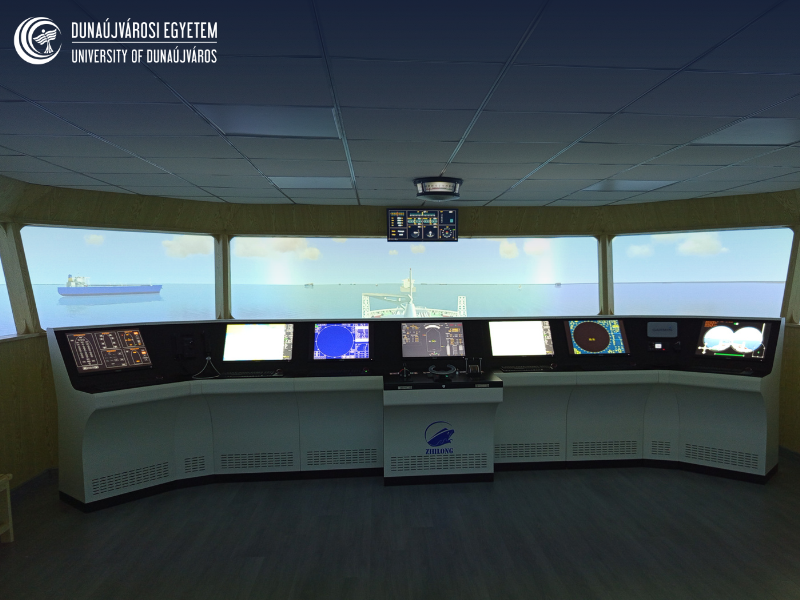
(Students gain practical experience using the college's ship bridge simulator. Photo: Tamás Zahola)
Beyond regular classes, students can also participate in afternoon extracurricular activities and become involved in advanced technological projects, such as testing autonomous vehicle control systems and maritime-related technical solutions.
Tamás Zahola emphasised that students are students everywhere: young, open, curious, and closely connected to their mobile phones.
The visit also revealed the diversity and complexity of contemporary China. Traditional institutional structures and a strong sense of collective responsibility exist alongside advanced high-tech solutions in a highly competitive economic environment.
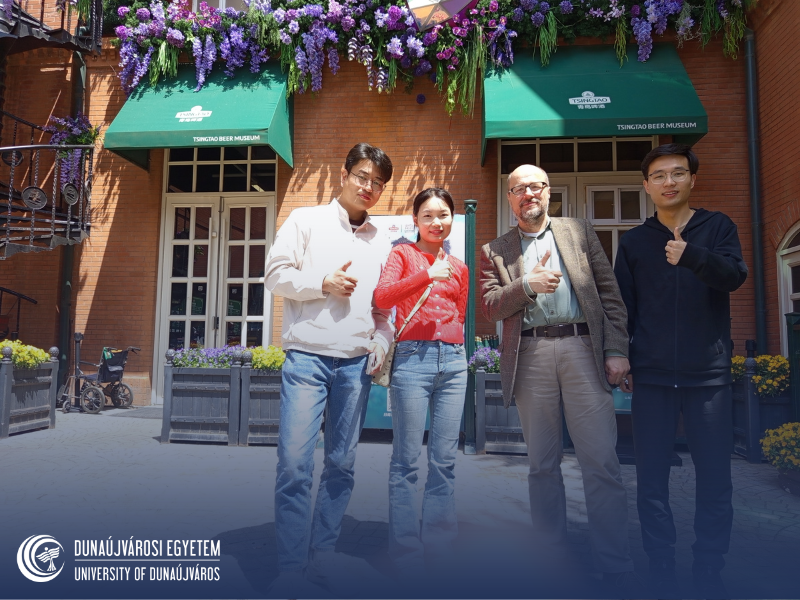
(Teaching mobility strengthens cooperation between partner institutions and cultures. Photo: Tamás Zahola)
Tamás Zahola’s teaching experience in Qingdao once again highlighted the importance of international higher education cooperation. Such mobility programmes not only provide lecturers with the opportunity to teach abroad, but also help them better understand different educational systems, students’ learning habits, institutional priorities and cultural environments.
Sometimes, we truly need to see in order to understand.

