



|
Date: |
Organizing Unit: |
|
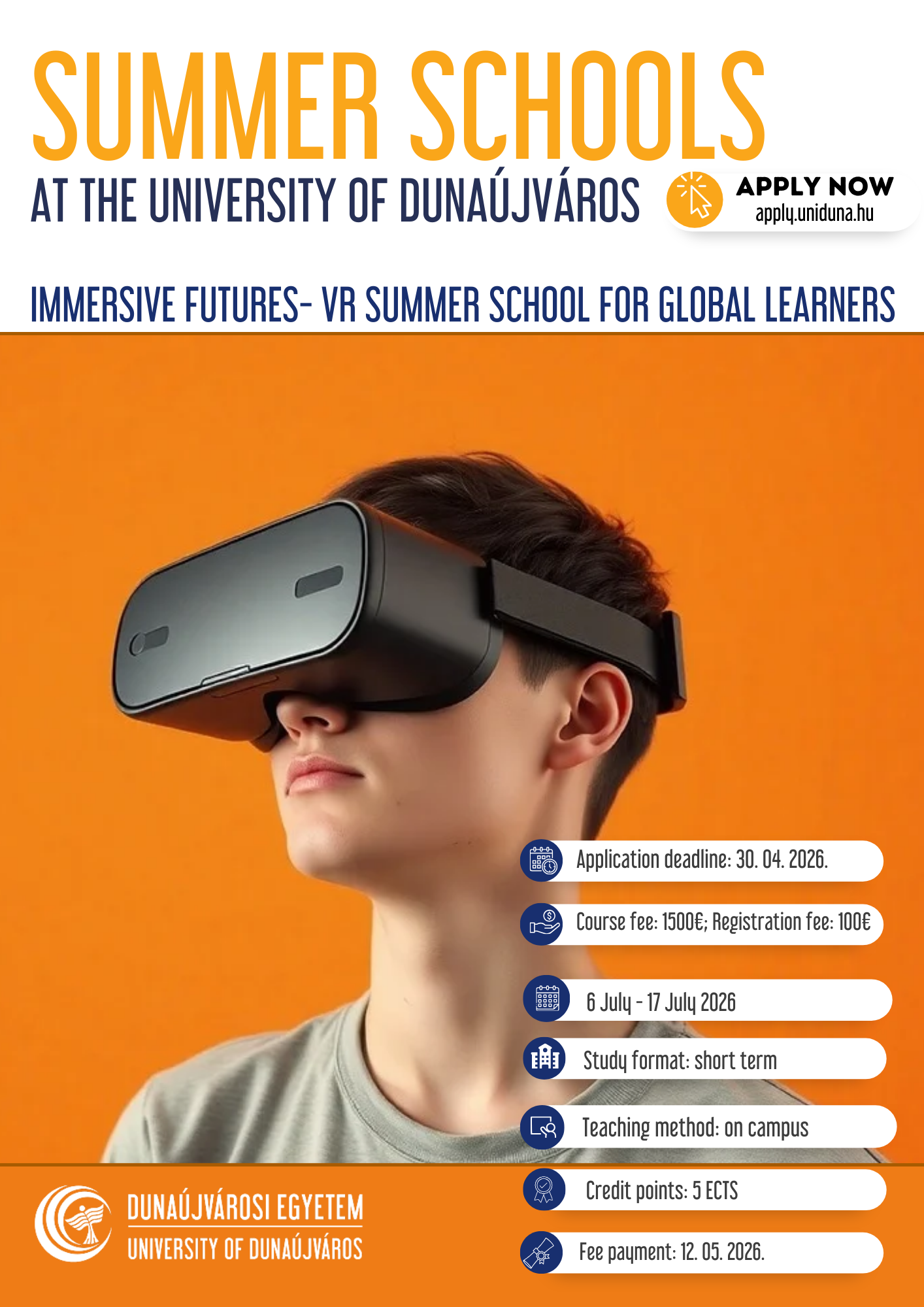
6 July – 17 July
|
Teacher Training Centre |
|
Language of Instruction |
Credits |
|
English
|
5 ECTS
|
|
Course location |
Course fee |
|
On-campus |
1500 EUR
|
General information about UOD Summer Schools
Summary
This course offers an immersive and practice-oriented introduction to Virtual Reality (VR) technologies applied in space science, education, and related technological fields. It is designed as an international Summer University program that combines pedagogy, cutting-edge VR tools, and space exploration content. Through interactive virtual environments, students gain first-hand experience with scenarios that are otherwise physically inaccessible, such as space missions, orbital operations, and planetary exploration. The course introduces the fundamentals of space research, Earth observation, drone technologies, and their combined use with VR systems. Participants explore the structure and functioning of the universe, the Solar System, and key celestial bodies, with a special focus on Mars.
Students virtually visit and interact with the International Space Station, practicing zero-gravity movement, docking procedures, maintenance tasks, and spacewalks. The course also presents detailed simulations of historical and contemporary space missions, including the Apollo 11 mission and NASA’s Space Launch System. Learners experience the full process of space travel, from Earth-based preparations to orbital insertion and planetary landing. Realistic VR simulations allow students to operate rovers, conduct surface exploration, and manage mission-related challenges.
The program emphasizes experiential learning through guided VR tours, interactive videos, and hands-on simulations. Drone technologies are introduced in both theoretical and applied contexts, highlighting their role in space research, Earth observation, and mapping. Repetitive virtual routines help students internalize complex systems, operational rules, and safety principles. The learning environment encourages exploration, experimentation, and reflection on decision-making processes.
Throughout the course, students develop a systems-level understanding of space missions, technological interdependencies, and operational sequencing. The program supports autonomous learning by allowing participants to choose tasks and missions aligned with their interests. Ethical, safe, and responsible use of digital technologies is also emphasized. Overall, the course provides a comprehensive, engaging, and future-oriented learning experience that bridges education, technology, and space science through VR.
Target group
The course is designed for international undergraduate and graduate students interested in space science, technology, education, and innovative learning methods. It is particularly suitable for participants with an interest in VR, simulation-based learning, and emerging digital technologies, regardless of their prior technical background. The program also welcomes future educators, researchers, and professionals seeking interdisciplinary and experiential learning opportunities.
Course aim
- To introduce students to the fundamentals of space science, space missions, and related technologies through immersive VR environments.
- To develop practical skills in virtual navigation, mission execution, and technology operation within simulated space scenarios.
- To enhance problem-solving, systems thinking, and decision-making abilities through interactive and mission-based learning.
- To demonstrate the educational and research potential of VR and drone technologies in space-related contexts.
- To foster autonomous, responsible, and reflective learning aligned with modern pedagogical and technological standards.
WHY this Summer School?
- Immersive, hands-on learning: Experience space missions, planetary exploration, and advanced technologies through state-of-the-art VR simulations that go far beyond traditional classroom learning.
- Future-oriented skills: Gain practical knowledge in virtual reality, space technologies, and drone applications that are increasingly relevant in education, research, and technology-driven careers.
- Unique international experience: Learn in an innovative, interdisciplinary environment alongside international students, supported by expert instructors and cutting-edge digital tools.
The classes will be taught by highly experienced academics. Students will receive official Transcripts of Records upon completion of the program. The program includes various interesting and enjoyable social programs and excursions.
Application: please contact us at This email address is being protected from spambots. You need JavaScript enabled to view it. or click the Apply button below

Course fee: 1600 EUR
This includes:
- Registration fee (100 EUR)
- All tuition, including lectures, seminars, and tutorials.
- Assessment, transcript of academic performance, and certificate.
- Accommodation at the student hostel of the University
- Breakfast and lunch during the summer course
- Social activities, including two excursions to the Hungarian countryside
For information about cancellation and refund policy and visa related information please visit the Summer School/General Information menu point.

